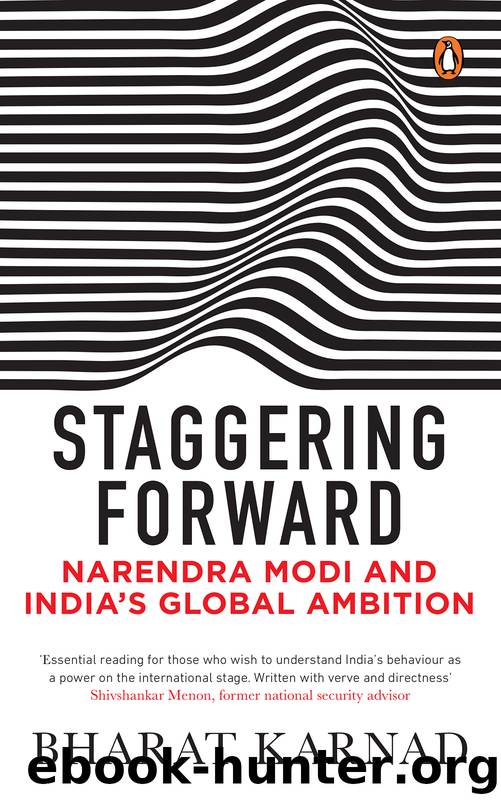
Staggering Forward by Bharat Karnad
Author:Bharat Karnad
Language: eng
Format: epub
ISBN: 9789353051952
Publisher: Penguin Random House India Private Limited
Published: 2018-07-22T16:00:00+00:00
Intensifying Engagement with Afghanistan
However India’s relations with Pakistan pan out, they are inextricably linked, for historical reasons, to India’s ties with Afghanistan. In the present day, Pakistan sees its interests as served by having a Taliban government once again running the country. It was during the Mullah Omar government (1996–2001) when Afghanistan was internationally isolated that Pakistan’s stock shot up in Kabul. It fronted for the Taliban regime and was its window to the world and the medium through which it conducted its severely limited diplomatic and economic relations. Moreover, being militarily weak, Mullah Omar’s Kabul permitted the GHQ to once again think of the Afghan territory in terms of ‘strategic depth’ for the Pakistani Army to retreat to in case of conflict with India. It was also the time when India’s profile and presence in Afghanistan was thin. That was an exceptional period because India and Afghanistan acting in concert is more the historical norm.
Starting soon after Independence and Partition, the Pakistani government began complaining to London about India’s anti-Pakistan machinations in league with Kabul. Afghanistan’s position in 1947 was that because Pakistan’s North-west Frontier Province habited by Pashtu-speaking Pathans had been carved out of Afghanistan by Britain after its imperial wars, it should be returned to Kabul’s jurisdiction by the departing colonial power. Nehru wanted to make sure that Partition and an independent Pakistan did sever India’s historic links with that country. Pakistan–Afghanistan relations have simmered ever since. The British Foreign Minister Harold Macmillan, for instance, noted in his diary of 21 November 1955 that the visiting Pakistani Prime Minister Chaudhary Mohammad Ali whined about Afghan intrigues on the Durand Line ‘egged on by Nehru’.36 Sixty years later, Islamabad continues to squawk, this time about the bigger role the Trump administration has ostensibly assigned India in Afghanistan in its new strategy for the subcontinent.37
Governments in Delhi, as part of their approach to Central Asia, have striven to maintain an Indian hand in Afghanistan, making sure that India has a say in the crafting of any final solution for Afghanistan whether on the battlefield or at the negotiating table. With this in mind, Indian intelligence agencies have befriended factions of the Afghan Taliban and, as backup, some groups in the TTP with connections in Taliban quarters across the Durand Line, tempting them with money and/or benefits in kind to pursue dual aims—fight the Americans if they choose to and, on the side, act to undermine Pakistani interests in the country.38 The Afghan pot can thus always be kept on the boil or the heat turned down to suit Indian interests even as people-to-people connections are cemented by the normal play of Bollywood films and music and Indian television programmes, and popular goodwill for India strengthened with development projects that visibly remind the Afghan people of India’s role in their national life. Managing clandestine Taliban operations targeting Pakistani assets in Afghanistan and supporting the TTP guerilla war in Pakistan are also seen as payback for the ISI’s sponsoring of LeT, JeM and Hizbul Mujahideen activity in Indian Kashmir.
Download
This site does not store any files on its server. We only index and link to content provided by other sites. Please contact the content providers to delete copyright contents if any and email us, we'll remove relevant links or contents immediately.
Whiskies Galore by Ian Buxton(42078)
Introduction to Aircraft Design (Cambridge Aerospace Series) by John P. Fielding(33173)
Small Unmanned Fixed-wing Aircraft Design by Andrew J. Keane Andras Sobester James P. Scanlan & András Sóbester & James P. Scanlan(32835)
Aircraft Design of WWII: A Sketchbook by Lockheed Aircraft Corporation(32329)
Craft Beer for the Homebrewer by Michael Agnew(18283)
Turbulence by E. J. Noyes(8110)
The Complete Stick Figure Physics Tutorials by Allen Sarah(7422)
The Institute by Stephen King(7088)
The Thirst by Nesbo Jo(7002)
Kaplan MCAT General Chemistry Review by Kaplan(6985)
Bad Blood by John Carreyrou(6669)
Modelling of Convective Heat and Mass Transfer in Rotating Flows by Igor V. Shevchuk(6492)
Weapons of Math Destruction by Cathy O'Neil(6362)
Learning SQL by Alan Beaulieu(6334)
Man-made Catastrophes and Risk Information Concealment by Dmitry Chernov & Didier Sornette(6137)
Permanent Record by Edward Snowden(5889)
Digital Minimalism by Cal Newport;(5834)
Life 3.0: Being Human in the Age of Artificial Intelligence by Tegmark Max(5616)
iGen by Jean M. Twenge(5452)
